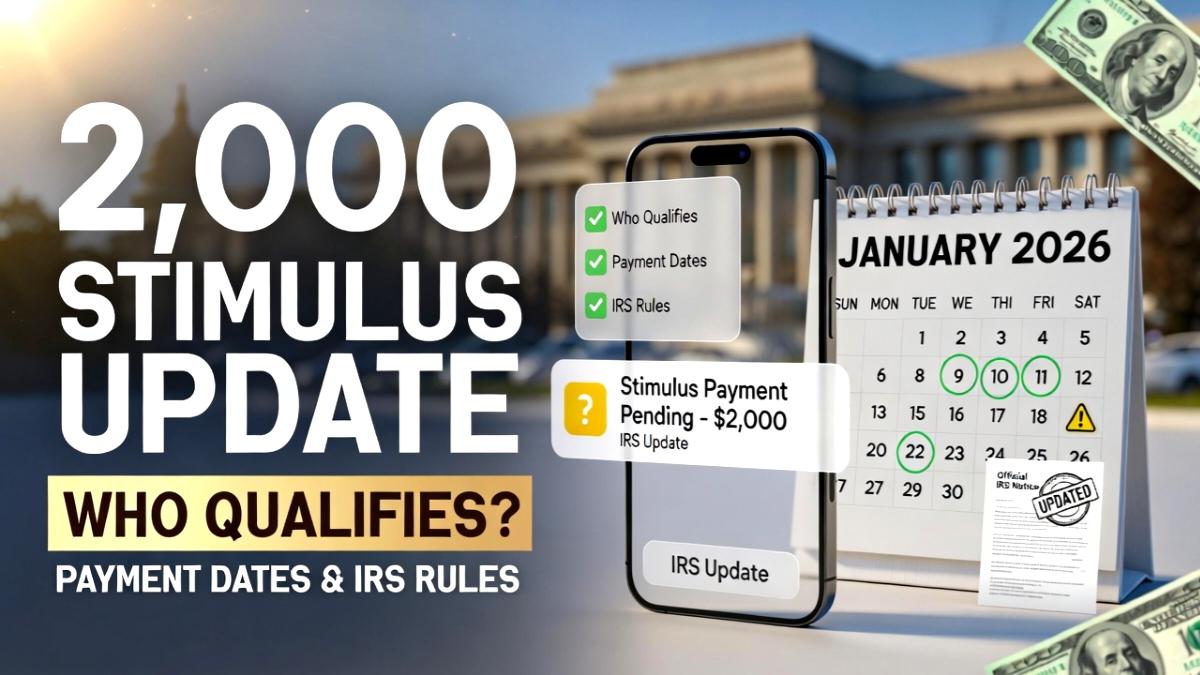
$2000 Stimulus Check Update: Interest in a possible $2,000 stimulus check has increased again as January 2026 approaches. Social media posts, online articles, and forwarded messages claim that all U.S. citizens may soon receive a new payment. For families dealing with high prices and financial stress, these headlines naturally create hope. However, the reality behind the $2,000 stimulus check discussion is more complex than many viral claims suggest.
At this time, there is no confirmed universal $2,000 stimulus check approved for every American. While some people may receive payments close to this amount, these are tied to existing federal systems rather than a brand-new stimulus program.
What People Mean by a “$2,000 Stimulus Check”
The phrase “$2,000 stimulus check” is often used loosely. It is not the official name of a government program. In most cases, it refers to money people receive through regular federal processes such as tax refunds, refundable credits, or benefit adjustments. Because these payments sometimes total around $2,000, they are mistakenly labeled as stimulus checks.

This confusion grows when multiple payments arrive close together. When people see a deposit near that amount, it can easily be misunderstood as a new nationwide relief payment.
Why There Is No Universal $2,000 Payment
A true stimulus check requires approval through federal legislation. As of now, no law has been passed that authorizes a new $2,000 payment for all U.S. citizens. The IRS and other agencies only issue payments that are already allowed under existing programs.
Federal payments are always based on eligibility rules. Income, filing status, dependents, and benefit enrollment all determine whether someone receives money and how much they receive.

Who May Still Receive Around $2,000
Even without a universal stimulus, some individuals may still receive deposits close to $2,000. This usually happens through tax refunds or refundable tax credits. People who overpaid taxes, qualify for child-related credits, or are eligible for income-based credits may see refunds reach or exceed that amount.
Others may receive retroactive benefit adjustments or combined payments from federal programs. These payments are legitimate but should not be confused with a new stimulus initiative.
Eligibility Depends on More Than Citizenship
Citizenship alone does not qualify anyone for a $2,000 payment. Eligibility is determined by financial and program-specific rules. Taxpayers must file a return and meet income requirements to receive refunds or credits. Benefit recipients must already be enrolled and meet program guidelines.
Two people reading the same headline may have completely different outcomes. One may receive a refund while the other receives nothing, even though both are U.S. citizens.
How Payment Timing Actually Works
There is no single date when $2,000 payments are released. The IRS processes payments on a rolling basis. Timing depends on when a tax return is filed, whether it is accurate, and whether additional verification is required. Electronic filing with direct deposit usually results in faster payments.
Some payments arrive earlier, while others take weeks. A delay does not mean denial. It usually means the return or benefit requires extra review.

How the IRS Sends Money
The IRS does not send money randomly or based on headlines. Payments are issued only after eligibility is confirmed. Direct deposit is the fastest and most secure option. If banking information is not available, payments may be sent by paper check or prepaid debit card.
Accuracy is a priority for the IRS. This focus on verification is why payments may take longer, even when the amount is similar for many people.
Avoiding Misinformation and Scams
Misinformation spreads quickly during tax season. Claims of “guaranteed” $2,000 stimulus checks are often exaggerated or false. Scammers take advantage of this confusion by sending fake messages asking for personal or banking information.

The IRS never contacts taxpayers through unsolicited texts, emails, or social media messages. Relying on official government sources is the safest way to stay informed.
What Taxpayers Should Do Now
The best way to ensure any eligible payment arrives smoothly is to file taxes accurately and on time. Double-checking personal details, income forms, and banking information helps avoid delays. Using direct deposit significantly improves payment speed.
Monitoring official IRS tools allows taxpayers to track progress without relying on rumors or unverified claims.

Why These Payments Matter to Families
For many households, a payment near $2,000 is not extra spending money. It can help cover rent, utilities, groceries, or medical expenses. Seniors, low-income families, and people on fixed incomes often rely on refunds or credits to stay financially stable.
Understanding the facts helps people plan realistically instead of waiting for payments that may never come.
The idea of a $2,000 stimulus check for all Americans is misleading. While some individuals may receive payments close to that amount, these come from existing tax and benefit systems, not a new universal program. Eligibility rules and accurate filings determine who receives money and when.
यह भी पढ़े:
 2026 IRS Income Tax Refund: What Americans Should Know About Refund Timing and Filing in 2026
Staying informed through official sources helps replace confusion with clarity. Knowing how the system works allows Americans to prepare with confidence rather than uncertainty.
Disclaimer
This article is for informational purposes only and does not confirm a universal $2,000 stimulus check for all U.S. citizens. Payment amounts, eligibility rules, and timelines depend on individual circumstances and official government policies, which may change. Readers should consult IRS resources or qualified financial or tax professionals for guidance related to their specific situation.